Saturday, 15 June 2013

Trilby Station

 We found Trilby Station very relaxing during the 10 days that we spent there.


We camped on the Billabong and enjoyed watching all the wild life.


This photo was taken from right behind the caravan where we were camped.
The Zodiac was great for traveling up and down the billabong and trying to catch one of those illusive fish.


The Trilby Station information below was supplied by the station owners Gary and Liz Murray.


TRILBY STATION POINTS OF INTEREST

Trilby Station itself is 127,721 acres (51,686 hectares). Approx .26,000 acres is Darling River flood plain with heavy, grey self mulching soils. The remainder of the property is red loam scattered with Leopardwood, Beefwood, Sandlewood, Rosewood, Ironwood, Bimblebox and good edible Mulga trees. The Mulga trees can be pushed with a bulldozer or cut in drought times to feed stock. They regenerate over time. The branches of the Leopardwood tree are also good drought fodder. In drought times the stock will come running as soon as they hear the bulldozer - knowing they are about to be fed!

Trilby is sub-divided into 18 paddocks, with 4 holding paddocks and is watered by the Darling River, ground tanks (you may call them dams) and bores - one of which is a flowing bore. Most of the bores are equipped with windmills, though we are gradually changing over to electric (or solar) mono pumps. The West Trilby block is bisected by Cuttaburra Channel Country, growing lignum and cane-grass and is subject to periodical flooding from the Paroo River. In 2011 we saw the Paroo and Cuttaburra in flood for the first time since 1990 and we are currently experiencing another smaller flood there this year. Although this has necessitated the construction of a levee bank around the West Trilby shearing shed and huts to keep the rising floodwaters at bay, we are incredibly pleased to see so much country now underwater. It will grow a magnificent volume of feed after the waters recede. It is 90km from the Homestead to the West Trilby shearing shed.
In 2008 we added 'New Chum' to our holdings, and last year 'Mt Mulyah' and 'Pelora', bringing our total area to just over 320,000 acres. These properties were all apart of the original Dunlop and adjoin Trilby, simplifying management.

Feral goats are a very important income factor for us, being the most widely exported meat out of Australia, mainly to Muslim countries. And, believe me, there is no shortage of them out this way, as you've probably noticed on your travels to Trilby. A female goat  (Nanny) begins breeding at about 7 months, has 2 'kiddings' a year... and often bears 2, 3 or 4 kids at a time!! Better than rabbits! They graze on scrub rather than grasses so areideal for our very scrub infested country back off the river. Being feral, they wander (into the wind), going straight through your fences. The goats are only considered yours to muster when they are on your property.
Sale price varies from around $14 per head to upwards of $50, depending on the supply/demand at the time. 17kg is the minimum going weight, and we can sell per head or 'over the hook' which is a cents per kilogram rate. If the majority of our sale goats are smallish to average, around 17-20k9 we take the per head rate, however if we have a big mob of huge billies (yep, the guys) we'll choose the over the hook rate. Early last year the per kg rate was $1.46.... making for around $60 for the big guys. As I type now, the rate is around 50 cents a KG...making the big guys worth only around $20!! This is due to the dry year we've had and an oversupply of goats. Farmers are spending more time rounding up the goats to get rid of them off the farm (more grass and feed for sheep and cattle).Sheep/cattle/wool prices have also fallen in the past 12 months so farmers are again relying on goats for increased income, and are therefore mustering more of them.  Supply has overstepped demand.
We sell live to the local Louth goat depot, who pickup from our yards at no cost. The goats are trucked to Albury Wodonga, on the VIC border, blessed and slaughtered Halal style for the Muslim market. Without a doubt, no grazier would still be viable here in the Western Division without the income provided by feral goats over the years.  In recent years we've constructed goat proof fencing (electric and ringlock wire) on a portion of Trilby to enable us to keep the nannies and kids, just selling off the billies. These paddocks have one way trap gates, allowing goats to enter but not leave. They are very effective indeed. We've also constructed small trap yards around watering points, with the same one way gates as well as ramps ( as goats love to jump), and use these over summer when there is no other water source for them to access... making the catching a simple matter and forgone conclusion.
Western NSW is lease-hold country and the Western Lands Commission rate us at one dry sheep to every ten acres (a dry sheep is one without a lamb at foot) on Trilby and one sheep for 12 acres on Newchum, Mt Mulyah and Pelora. Our stock numbers have been down for many years, due to the extreme drought. Until mid 2010 we have been consistently drought declared since October 2001. Over a three day period in January 09 we received 105mm (420 points) of rain - our biggest fall in 92 months!! However, with no follow-up rains, the grasses generated soon perished in the hot sun. The Gods have finally seen fit to shine on us and since around October 2010, when we received five and a half inches of rain overnight, we've been receiving reasonably consistent falls.

In drought years we hand fed barley to many of the sheep for a period of time, drought rations, but enough to keep them going... trying to hang on to our breeding ewes as long as we could. . . till the rains came. At a cost of about $ I per sheep per week, (Barley was costing us about $360 a tonne plus freight.)... this understandably was restricted to absolute necessity only.
Currently we're carrying around 20,000 merino sheep (up from 17,500 in2012). Approx 12,200 ewes are joined to Haddon Rig stud merino rams, due to lamb out in spring.
 Following the improved season in 2010 we marked 7,384lambs that year - an average of 92%. However in 201 1 we only marked around 690 , {6,400 lambs) and last year 6,041 lambs - 57% - very surprising considering the fantastic season we were having. Low lambing percentages was a common problem throughout Western NSW, resulting in a webinar to attempt to unravel the causes.
One property in our area scanned 120 per cent fetuses per ewe yet marked only 30 per cent - so it wasn't a fertility issue or lamb loss at lambing, thus authorities tried to uncover exactly where and how those lambs were lost.
Factors which could have contributed include: worms - a major problem last season, they reduce body condition making sheep sick and in severe cases causing death. A combination of heat and humidity can cause heat stress which can produce small lambs with less chance of survival at birth. Mosquitoes and other biting insects can transmit viruses and infections which could directly affect unborn lambs, or indirectly through their mother's increased body temperature. Increased fox, pig and wild dog populations due to the excellent season and flooding could be impacting on lamb survival.
Sheep spending extended periods in waterlogged pastures, leading to foot and skin infections.

In2004 we marked just 90 lambs and in 2005 we didn't join at all, as it was just too dry and the ewes too poor. The ewes often don't 'cycle' in a bad drought and if they do manage to lamb they often abandon them anyway... rain arrived in June 05 - which was too late to join ... but fortunately, thanks to a visitor who left a gate open.... we ended up with about 600 'immaculate conceptions'.

Roughly half of each year's lambs are whethers ( so, boy sheep that we castrate), and these are sold online via 'Auctions Plus'... which is like Ebay for sheep, Our 2010 whethers were sold for $ 1 18 per head ! ! We decided to hold onto our spring 2011 whether lambs until after shearing last year, hoping to grow them out a bit more for an improved price. That way we also got the wool from them. They sold for $80 to Country Fresh, an abattoir in Tamworth. An accredited assessor visits the station to inspect a cut (around l0%) of the mob to be sold. Each sheep is individually weighed and assessed for condition, wool quality (such as length, whether there is a large amount of burr and dirt in the wool for instance) and photographs of the mob are taken. These are then uploaded onto the livestock auction site and on the day of sale prospective buyers bid for your sheep. This system works very well for us as the nearest sale yards are Narromine, 440km away. It costs a lot per head to cart sheep to sale, meaning you are committed to sell, regardless of the maximum bid received... as you simply can't afford to truck them back home again. By selling online you have a reserve, so the sheep only sell once the reserve is met. If they don't sell there has been no cost to you (as the sheep are still in the paddock) ... and if they do, the buyer pays the freight to get his stock home.
We class our young ewes and cull off anything that doesn't have a good conformation or who's wool isn't fine enough for our flock, and while these are our cull sheep (rejects) they are top notch to others not quite so fussy. Obviously... as the buyer paid $214 per head in 2012, a price we've only ever dream't of in the past.

Our busiest (and most exciting time of the year as wool producers) is shearing, which begins mid May for about a month. We expect to get around 460 bales of wool when shearing is completed this year. A bale weighs around 186 kg, which is the wool from around 32 grown sheep. A grown sheep this year will produce about 6kg of wool, down just over a kg per head on last year ... due to the super good season, too much rain etc. ironic isn't it!! So for 17 ,686 sheep, which includes 6,152lambs - we expect to end up with around 446bales. Wool prices are currently falling due to the uncertainty in Europe, but we hope to achieve about $1200 bale.  lt costs us around $12 per sheep to shear. $7 goes directly to our contractor (he brings the whole team... so 6 shearers, shed hands, wool presser, wool classer, pen-er-uppers (a term our kids still use, denotes the guy who pens the sheep up ready for the shearers to shear them!!), cook and all the groceries they require. We provide a clean bed with mattress cover and pillow per shearer and a clean set of quarters and the team simply moves in for the duration. The remaining costs to shear a sheep include chemicals, woolpacks, cartage of wool to sale and staff wages.
Due to the size of our station we have 4 shearing sheds, each with its own shearer's quarters. The shed here at the homestead, one at West Trilby - about l00 km from here, one at Newchum - about 40 km from here and one at Mt Mulyah, about 65km from here.
As the sheep in the vicinity of each shed are shorn the team moves to the next shed and mustering continues.

During the flood last year and for a similar period in 2011 we were completely surrounded by water here at the Homestead for three to four months. We needed to either fly or boat to leave the island, a novelty to begin with but it wore quite thin by the end, believe me. The flooding resulted from the Dec 2011 flooding around the Moree area, and then the St George/Charleville floods in January 2012.. Most rivers on the eastern side of Australia, and west of the Great Divide, eventually end up flowing into the Darling River. Flooding here is not overnight/instant... we have weeks to prepare, allowing us time to move all of our stock onto higher ground, replenish the gas bottles, pantry etc and be organized.
I leave my 4WD on the Louth airstrip, (20 kilometres away) so that should I want to go to town Gary would fl me there, where I couldn't drive to Bourke, as that road floods, but I could head Cobar way and beyond. With the Toowoomba floods tagging onto the previous one, and the river not dropping enough in between to allow us to resupply, we needed the assistance of the SES on one occasion - they slung some drums of avgas fuel in for our aeroplane with a chopper ... enabling us to remain self sufficient and not have to rely on them totally.

We have 3 working dogs. Plugger is the black and tan Kelpie/huntaway, Rudi is the brown kelpie and Tannie, the smallish black/tan Kelpie Huntaway with the square house. During the floods last year a huge buck roo on our island lured Chikka (Rudi's sister) into the rivervand drowned her. Kangaroos are a very dangerous animal when cornered.

Huntaway's are a New Zealand sheep dog, very affectionate and great workers - but enormous. We normally cross them with the Kelpie to control size (can't fit too many huge dogs on the motorbike with you and they take up too much room in the plane!).

We took a few photos of some of the history items around Trilby

Steam engine used to drive various machinery.  The engine is mostly intact but like most others like this one, the boiler is rusted out.
The engine was built by R Hornsby & Sons Limited, Engineers, Grantham. England.
Two fencers that worked on Trilby full time started out with these 2 old Holdens.
This is where they stayed when the broke down
They then advanced to this old Chev truck and when it broke down......
...they advanced to this double decker bus.  Unfortunately, they hit a low bridge with it and wiped the front of the top section off

Saturday, 30 March 2013

USA Trip for Technical and Maintenance Convention in Nashville

In October 2012, I won the prestigious Craig Roseneder Award for Technical and Maintenance Excellence in the transport industry. 
This award which is organised by the Australian Trucking Association is sponsored by Castrol and presented at the Technical and Maintenance Conference Awards Dinner each year. The major prize for this award is an all expenses paid trip to the United States of America to attend their Technical and Maintenance Council annual convention.
Judy and I had never planned to travel overseas but we soon came to grips with this prize and got the trip organised.
As we were going to spend so much time in an aeroplane to get there, we decided to make a trip of it and have a bit of a look around while we were there. 
We flew into Los Angeles where we stayed at Beverly Hills. 

Eddy Murphy's House in a gated estate
As typical tourists, we took a sight seeing tour of the area to see where all the movie stars lived. There were huge mansions tucked in behind high hedges and wrought iron gates, but the tour guide knew where all the stars lived. 
We saw where Hugh Jackman, Cher, Madonna and Nicole Kidman and a lot of other stars lived. We even saw the gates of the house where they brought Michael Jackson out in the ambulance after he passed away.  Nice area to visit but I wouldn't like to live there.

Los Angeles is a big city so we decided to do the city tour to get our bearings. The tour took in the sights and of course we walked along the footpath with all the stars and saw the Hollywood sign up on the side of the hill. What an amazing place. 

People were dressed up as movie stars and just walking along the footpath. Judy and I aren't movie buffs so most of it went straight over our heads, like our daughter Leann said, it was a waste us going their as we wouldn't know a movie star if we tripped over one. The tour finished at the LA Farmers market for lunch.
The next day we decided to take the bus back into LA to have a closer look at some of the places we had seen on the tour. Now we have never been ones for public transport so this was a big adventure for us. 

Judy at the Walk of Fame with Nicole Kidman
First was the bus to the railway station and then the underground rail into town. Like our daughter Karen told us, it's not hard once you put your mind to it.

Madam Tussaud's wax museum was top of the list. We were very surprised just how real the wax works looked and that you could put your arm around them for a photo.  


Of course being in LA it was all movie stars from past and present. The hair was the only part that we weren't allowed to touch as every strand had been put in by hand and would have been easily damaged. 


The wax works were very real looking and I am sure that I could have had a conversation with this one.
Rodeo Drive has been made famous in a lot of movies and TV series and don't the take advantage of it. Shopping along that road was very exclusive and expensive but it was good to see how the other half live.  

If you had about half a million spare cash you could buy a McLaren sports car from the local dealer in Rodeo Drive. Apparently McLaren had just released their road car and they were selling like hot cakes. We did see one parading around up and down Rodeo Drive.


Just along from the corner of Rodeo Drive and Wilshire Blvd. is the hotel where Julia Roberts stood on the balcony in a scene from the film Pretty Woman.


From LA we flew to Nashville in Tennessee for the business part of the trip that we were in America for.
The Technical and Maintenance Council hold a conference each year to discuss technical and maintenance issues within their transport industry. As  big percentage of our transport equipment originates from North America, it is important that the Australian transport industry keeps up with what is going on in America as that equipment hits our shores shortly after it is released in America. 
View from our room's balcony
The convention was held at the Gaylord Opryland Hotel which is right in the hart of the originating area of American country music. This hotel is 9 acres under roof and has the most magnificent atriums and gardens, all under the roof and flanked by the guests rooms. The place is so big that I didn't go outside for the 5 days that the convention was on.

There were over 1,000 delegates at the convention as well as just over 330 exhibitors showing everything from trucks, trailers, parts, tools, service programs, electronics, lights, GPS and a host of other transport related items.
The convention was very well organised with a host of very interesting subjects every day which made up a very full program. Some of the highlights of the convention to me were;

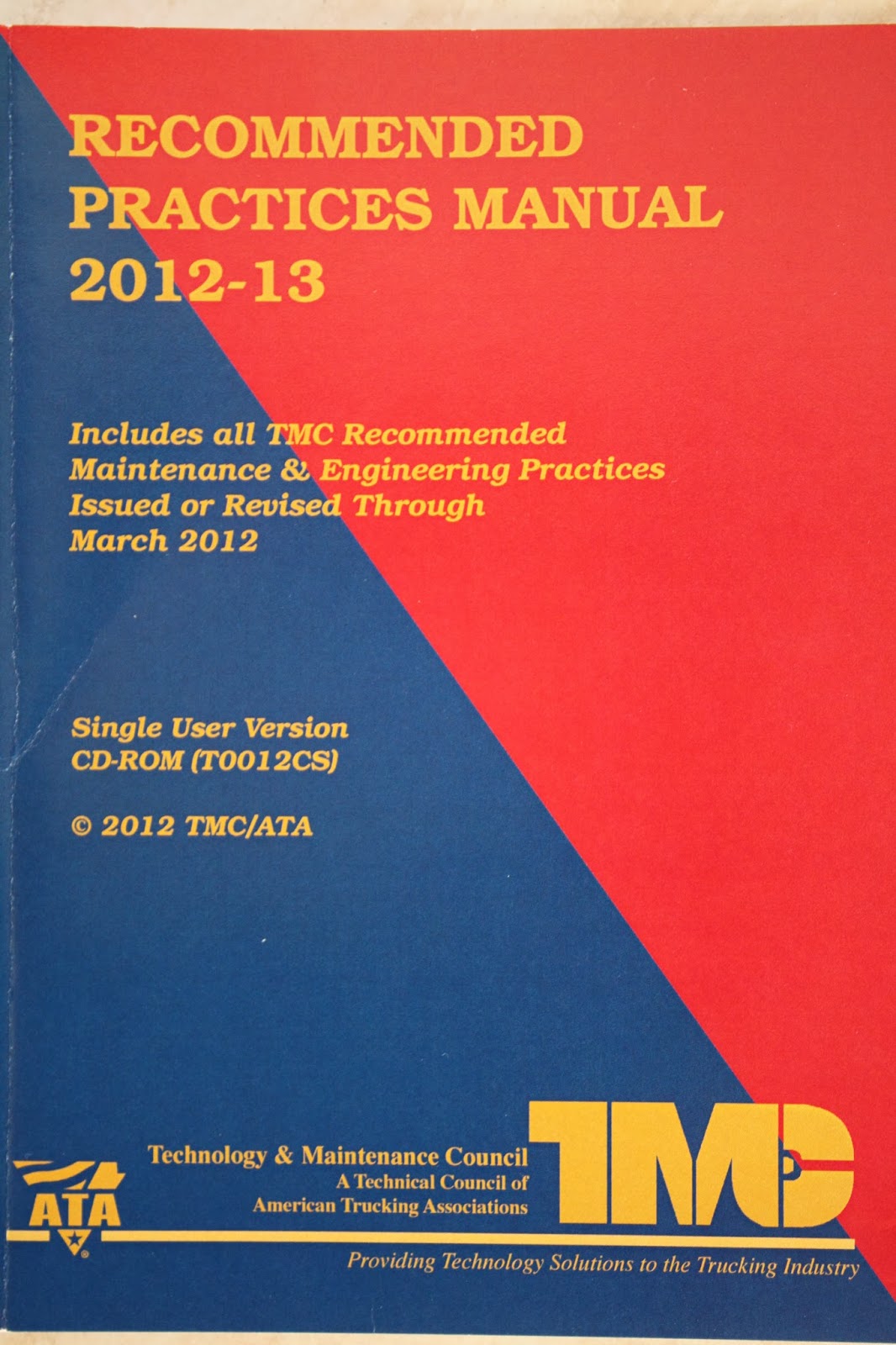
Recommended Practices (RP's) are top of the agenda at TMC and taken very seriously.  Small committees gather to discuss how best to do a certain job and then write a draft RP.  This is up for discussion at the TMC and people can then have input.  Once the Committee is satisfied that the RP is right, it goes to a vote at the TMC and if the majority vote in favour, it is accepted and distributed to all paid up TMC members.  A lot of work and research goes into each RP by some very experienced people.  I was lucky enough to be given the CD with all their RP's on it.  They are an excellent source of information.  The CD can be purchased on line at http://www.atabusinesssolutions.com/ATA/ATAProductDetail.aspx?ProductId=1135209


One of the interesting ones just starting was the issue of wheel bearings. Preload or end float. This is for the older hubs that we were all taught to give the bearings end float, the bearing manufactures are now coming out and saying that a small amount of preload will reduce the amount of axle stub wear and bearing wear. This stunned the audience. One older chap got up and asked for clarification that what he had done for the past 40 years was wrong. The presenter said that what had been done in the past wasn't wrong for that time, but now that we know better, and have better manufacturing processes, that we need to change from end float to preload. He even presented a method and some simple tooling for getting the correct preload. The RP committee for bearing preload was to come up with some recommendations for the next TMC.

An interesting web site to look at is


Side skirts fitted to help achieve better fuel economy
Fuel consumption legislation states that fuel consumption will be no less than 10 MPG(4.251 KPL) by the year 2025. This is a big ask given that current figures for current emission standard, diesel fueled Class 8 combination (5 axle
articulated vehicles up to 40 long ton (40,641 kg)), is sitting at 6.2 miles per gallon. (2.635 KPL)
Some interesting points came out of these sessions
Harvesting exhaust energy using a "turbo" type device gear coupled to the flywheel so the exhaust gas helps to power the motor
Better aerodynamic design of truck and trailing equipment
Lighter weight materials and chassis design
Improvements in turbo efficiency
Better after treatments and electronic controls
Waste heat recovery. A 2009 diesel engine only has a thermal efficiency of 42% so what can we do with the other 58% which is currently wasted
Improved fuel systems and combustion modelling
Reducing revs to 1,170 RPM at cruise speed
Hybrid automated transmissions will become more necessary for drive-ability at lower revs.
Recovery of braking and other thermal losses from exhaust and EGR
Reducing parasitic losses by fitting clutches to air compressors and water pumps.
Fit electric power steering pumps and better air conditioner compressor control
Platooning - ways of increasing efficiency by optimising the distance between the vehicles therefore reducing air drag and saving fuel and exhaust emissions. Uses V2V & V2I communications via Wi-Fi, Bluetooth and radar. 
The 21st Century Truck Partnership has been formed to look at how this is all going to be achieved. There are 15 partners to the program and they have a budget of $287 million to build a super truck.
USA has Green House Gas legislation on top of exhaust emission legislation. This calls for; 3% improvement required by 2014 over 2010 baseline and a further 5% improvement by 2017.
Emissions label to be fitted to the vehicle by 2014 to show what equipment is fitted to achieve GHG rating.
Vehicle speeds must not exceed 65 miles per hour and must be fitted with idle shut down timers for less than 5 minutes.


Engine Manufactures Update Session highlighted some of the problems encountered with the new low emission engines.
Problems with the Diesel Particulate Filter (DPF) mostly amounted to operators not sticking to the engine manufactures recommendations for cleaning and maintenance.
DPF's are fragile and need to be handled with care
Keep the engine software up to date. They have seen engines in the field that are 11 updates behind. Manufactures are always improving software to fix little bugs so it is important to visit your OEM dealer regularly to keep up to date.
The 7th (SCR) injector also needs servicing in accordance with OEM recommendations
EGR coolers have had cracking issues
EGR valves have also given problems
SCR Nox sensors have had problems
Radiator maintenance and cleaning is essential because of the higher thermal load being put onto the cooling system
Diesel Exhaust Fluid (DEF) should be checked regularly with a refractometer
Drain air tanks regularly
Diesel Particulate Filters (DPF) have their own set of problems. Do they let the driver delay the regeneration cycle or just make it happen automatically. Some of the transport companies customers are saying that trucks are not to run the regeneration cycle while the truck is on their site. Of course this is unlikely as the engine and exhaust has to be at a given temperature, but if the propulsion engine is being used to run a PTO pump, then it could happen.
Cummins had their Ultra Low Emission System on display. This unit consists of a diesel particulate filter, a Diesel Exhaust Fluid (DEF) dosing valve, a Decomposition Reactor which converts the DEF into ammonia and then an SCR unit to convert the Nox to nitrogen and water. All this equipment will take up a lot more real estate on the truck.


Wide Base Tyres seem to be making their way back into the industry with a very mixed reaction from speakers who are or have used them. 
Popular sizes are 445/50 R 22.5 and 455/50 R22.5.
Wheel size is 22.5 x 14.
Saves 1272 lbs (577 kg) over duals on steel rims on a 5 axle combination.
Fuel economy improvement between 2% and 5%.
Wide drive tyres are giving 240 to 260 thousand miles with just 1 front to back rotation.
Improved ride when fitted to drive.
Improved brake cooling.
To carry 11,000 lbs (5 tonnes) per wheel they need to be inflated to 120 PSI.
Tyre pressure maintenance is critical to tyre life.
Punctures usually destroy the rim as well.
Correct rim and axle specification is vital as a WBT on a 2'' outset rim has a 4" narrower track than duals.
Must use an axle with a parallel stub to get the bigger outer wheel bearing.


Shop Talk Sessions were very well attended. Some of the topics covered were
Wheel nut tensions and loss of wheel ends. More training and better tooling are the main 2 methods to over come these issues. 


Some excellent non impacting nut wrenches were demonstrated which seem to be the accepted method for tensioning wheel nuts.


How are companies providing enough power on their prime movers for all the "motel" extras that are needed to attract and retain drivers. CPAP machines for drivers with sleep apnoea,
Electric reverse cycle air conditioners, 
TV with video and even pay TV decoders, 
Microwave and even coffee machines are commonplace in interstate prime movers. 7 batteries are being fitted, 3 for starting and 4 for motel equipment 
Automatic engine start to recharge batteries
Most need an inverter to run all this equipment
Technicians do computer based training out of hours and at home.Some get paid at a lesser rate others get time and a half but there are financial incentives for technicians to do further training
Town Meetings / Fleet Operators ForumsVery well attended - hard to get a seat in the biggest room they had.
Suppliers had their top executives there to answer questions from the floor.
Suppliers say that they are afraid not to send their top as this means a lot to their reputation.
One operator told me that these sessions are worth between 5 and 10 K to him as he gets his issues resolved there and then on the spot.
Navistar copped it from all angles but their chief engineer was answering questions truthfully and their customers seemed to be satisfied with his answers
CNG and LNG Four speakers all with a similar story.  Some prefer LNG for class 8 long distance but short distance weight sensitive use CNG.  Big initial outlay for the vehicle especially LNG which is a 100% premium over diesel only.  Facility costs are also up as all space 18" down from the ceiling is class 1 zone 2.  Re-fueling station locations are a problem but are improving. $1 to $1.5 million to set up. They ALL say that they need the government grants to make the ROI work.  The vision is that still only 37% of the USA fleet will be on natural gas by the year 2025
Fully hot dipped galvanised dolly
Paint systems and hot dipped galvanising of chassis components is important in many parts of America and Canada because of the chemical treatment that is sprayed on the roads to help clear ice in the winter months. A lot of work is being done in these areas.

SAF Axle with adjustable trailing arm pin
The exhibition hall had about 335 exhibitors displaying their goods and or services. With that many exhibitors ,a lot of time was devoted to delegates being able to get enough time to talk to these folk. There was a good 4 hour session on the first evening to officially open the exhibition and give folk a first chance to have a look at the displays. Finger food was served during the evening. There were 2 other sessions dedicated to the exhibition and it was always busy. Exhibitors I spoke to all said that it was beneficial for them to attend. They weren't just locals but from all over the US and even Canada.

The convention dinner on the second last night featured Josh Turner who had 3 country songs in the top 40 charts while we were there. The show was awesome. We were invited to sit at the same table as the folk from the American Trucking Association who organised the convention. They were invited back stage to meet Josh and he have them a signed copy of his latest CD, which they then gave to us. What a lovely gesture.
After the conference ended, we stayed on in Nashville for another 3 days to give us the opportunity to have a look around while we were there.
There was a show boat that has lunch and show cruises down the  Cumberland River. It was great to get out into the fresh air once again after being in the air conditioned hotel for the 5 days. 


The show was Shotgun Red which featured lots of good country music and some very original comedy, without any swearing which made a pleasant change.


The following day we took public transport once again and ventured into downtown Nashville.
The college basketball competition was on over that weekend as well as being St. Patricks day eve, I don't think we could have picked a busier time to be there. The crowds were just overflowing out of the pubs and restaurants and the whole main street was closed off for one big party. The Yanks are sure passionate about their basketball.
Back on the bus again to get home we had a good chance to have a look at the typical American suburbs which looked to be big blocks and a lot without fences which gave a very open feel.


I don't think many people visit the US without going to Las Vegas, but why did they all have to go there the same day as us?  I thought Nashville was mad but it had nothing on Vegas.  No need to wait to start loosing your money at a casino, they have poker machines in the arrivals hall at the airport.
We arrived there in the evening of St. Patrick's day and the place was fair jumping. There were traffic jams on the foot paths and it was nothing to wait for 3 sets of lights at the pedestrian crossings. I remember thinking to myself that I was never going to survive this!  We found a bistro off the street a bit and decided that this would be a good place to eat. We qued for over an hour to get into the place but once we got in, the food was good.


By 10 pm we had had enough of the mad crowds so we made our way back to the Venetian  Hotel where we were staying and flopped into bed after a long tiring day, hoping that daylight would bring renewed vigor for discovering a new city.   We must have fallen asleep quickly and all of a sudden we were awoken by a strange roaring sound and a fiery glow at the window. 


We jumped straight out of bed and rushed to the window and all we could see were great flames coming from the hotel across the road. Before we had a chance to decide what to do, the flames suddenly died down to nothing. Few, what a relief, we could then see a lot of people standing around watching where the flames came from and could see that it was some sort of man made volcano out the front of the Mirage Hotel. The "volcano" kept erupting for about 5 minutes and then all went quiet. Wish they had of told us about this when we checked in. We were no longer asleep again and we found out that this happens every hour on the hour between 7 pm and midnight. Spectacular display. We were 40 stories above it and across a very wide road from it but it still lit up our room like daylight.
We woke up at 8 am the next day and looked out the window. It was a very different place from the night before with most of the mad crowd gone home. 


 Time to explore.
We once again took public transport in the form of a double deck sight seeing bus which took us all the way into the old Las Vegas and along both sides of "the strip". This gave us our bearings so we could discover further on foot.  We drove past the pawn shop where the TV program is made. There were people cued up right along the street just to have a look. They now have more visitors than customers. 


We were amazed at some of the buildings. The Excalibur Hotel is one of the highest in Vegas and it has a very tall tower on top. People can go up the tower on a "ride" and be dropped the full height of the tower, or even worse, you can be strapped into a mad mouse type ride and be let free fall over the side of the building. Not for us, we like to keep our feet on the ground. 


We walked about a mile up the strip in the evening to watch the water fountain display outside the Bellagio Hotel. This fountain is in a pool about 100 metres long and the water "dances" to a music and light show. Fantastic to watch. 
To see the fountain click here
http://www.youtube.com/watch?v=zhHMUKn5dhQ

Talk about a city of glitz and glamour with all the hotels having their own casinos trying to entice the punters in. It's funny that to get to any of the restaurants or shops from your room, you have to walk right through the casino.


Our hotel had this wonderful Italian feel to it with canals with gondoliers running through it. The courtyard was just as I imagine an Italian City would look. The roof was painted with sky and clouds so even during the night we felt as though it was daylight out side. We took a ride on a gondolier and were serenaded by an authentic Italian driver. Very romantic.
The next day started with a 5 am bus trip from the hotel to a nearby airport for a trip on a helicopter into the Grand Canyon. We had pre-booked a flight with Papillon Helicopters who organised all the rest for us. 


On the flight to the Grand Canyon, we flew over the Hover Dam which has a hydro electric scheme to help supply electricity to the power hungry city of Las Vegas. The main highway from Vegas to the Grand Canyon used to go across the wall of the Hover Dam but they have since built the highway around the wall as they considered it to be a terrorist target after 9/11. On the way to the canyon we crossed over the border into Nevada. The helicopter flew us right into the Grand Canyon and landed us right on the banks of the Colorado river where we took a boat ride up the river with a member of the Hualapai Indian tribe. 


We were told that the canyon was 4,000 metres deep and with the sheer walls you could see how that could be true. The canyon is truly grand as it goes back over 200 kilometres and is over 500 kilometres around the rim. The helicopter then took us to the top of the canyon where they have built the 
"Skywalk". 
This is an awesome piece of engineering as it is a glass bottom walkway that extends out over the edge of the canyon. From the walkway you can look straight down into the bottom of the canyon. 
Cameras are not allowed on the Skywalk so we don't 
have any pictures to share so click this link to see the official video.  http://www.grandcanyonwest.com/skywalktour.php


The same Indian people run the sky walk and they also have a typical Indian village set up for visitors to walk through to get an idea of their culture.   


Our Indian tour guide pointed out a lot of the features of the area, the most photographed is Eagle Rock because of its uncanny resemblance to an eagle with its wings spread out.


Leaving the bright lights of Vegas behind we flew to San Francisco in preparation for our trip home. We stayed at Fisherman's Wharf which is well out of the city and away from the crowds. San Francisco is home to 2 iconic attractions being the Golden Gate Bridge and Alcatraz, where a tour on the bay took us to both.


The Golden Gate Bridge is a very imposing structure.
It is a suspension bridge spanning the Golden Gate strait which is a mile wide, three mile long channel between San Francisco Bay and the Pacific Ocean. 
Its construction was started in 1993 and it opened to traffic in May 1937.  It is a total length of 2,737 metres and 65 metres high.  The cost to build the bridge was thirty five million dollars and it is estimated that it would cost about 1.5 billion to build.  Legend has it that there was one solid gold rivet put into the bridge at construction and it hasn't been found to this day.

Alcatraz is on an island only about 2 kilometres from the bridge and also about 2 kilometres offshore from San Francisco.  The tour boat took us around the island and we could see why Alcatraz was difficult to escape from. Firstly you had to get out of your cell and then get over or under the wall without being shot. Once outside the wall you would have to make your way down a very sheer cliff face and then into the water to meet the freezing conditions to try to swim to shore.


Fisherman's Wharf also has a lovely marina and harbour where cruise ships tie up to let their passengers off. 
One of Fisherman's Wharf's most popular attractions are the amazing sea lions on Pier 39. These sea lions came to Pier 39 some years ago during a storm and have stayed there ever since.
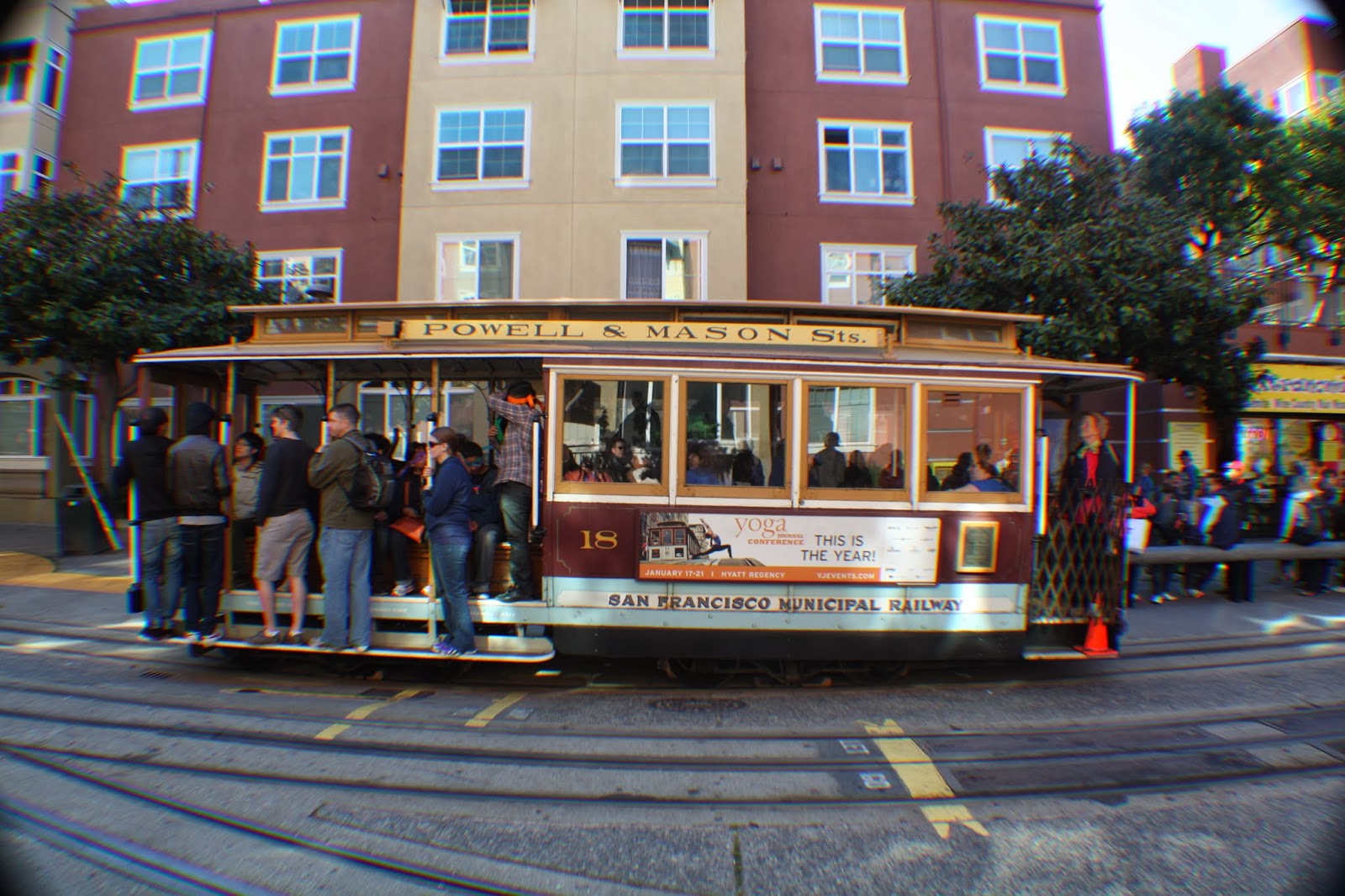
The cable cars of San Francisco are very unique and still in use today. It seemed like mostly tourists going for a joy ride but still a lot of city commuters use this form of public transport. 
Of course we hopped on for a ride. We qued up at the Fisherman's Wharf end of town for about 90 minutes for a trip into the business district of town. Cable cars are not like our trams which can be driven from either end. Cable cars always have to face the right direction so that the cable man is at the front and the brake man is at the back. There is a turntable at either end of the track so the cable cars can be turned around 180 degrees.
The cable man and the brake man get off once the car is on the turntable and push it around by hand.
There are rules about hanging off the side and getting on and off while the car is still in motion. Talk about rules are made to be broken as quite the opposite seemed to happen.

There are some very steep inclines and it appears that the cable cars actually stop in the middle of a cross road intersection so they can get started again.
In one instance all passengers had to get off and walk to the other side of the intersection as the hill was too steep to get the car rolling again. The cable man said that he would have just burnt the clutch out on the cable mechanism if he tried to get started again.
The picture on the right shows the view from the top of the hill back down into Fisherman's Wharf. Alcatraz can just be seen above the roof of the cable car.

Our trip ended with a late evening flight back to Los Angeles and then a 16 hour flight home to Melbourne.
This trip was a truly fitting end to a career in the transport industry spanning 43 years. 

There are some very important people to thank for helping to make this trip happen.
Firstly Cameron Dunn, Managing Director of FBT Transwest who put in the nomination for me to be considered for this award. I know the process is extensive to nominate someone for this award and the presentation of the nomination certainly goes a long way in the judges eyes.

I also greatly appreciate the generosity of Peter Gunn, the owner of the PGA Group which is the company that own FBT Transwest.

The Australian Trucking Association (ATA) who offer this award to maintenance personnel in the transport industry throughout Australia, and in particular to Tania Goodacre who helped us through our travel arrangements and organised the conference and excellent accommodation in Nashville.

Thanks also to Castrol who make excellent range of lubricants for trucks, cars, buses earth moving equipment and a host of other specialised equipment. Castrol are the major sponsor of this award and without their sponsorship, this trip would not have happened.

Thanks also to my wife Judy who put up with the perils of the transport industry, the long hours, the after hours call outs and the middle of the night phone calls etc. Thanks for organising this trip and coming with me to share in this once in a life time experience.


Friday, 1 February 2013

Welcome to our travel blog


What started out to be a diary of our trip for ourselves and a few family and friends, has now grown to have quite a few regular readers and new followers are being added at most places that we visit.

As a new reader, you might like to start at the beginning by clicking on the January 2013 heading in the archive list to the right of this page, and working your way down the list from there.

I will add your email address to my blog readers list, that way you will be notified every time there is a new post.  
By clicking the link I send you in the email, you will be taken directly to the newest post. 

Don't forget that we would love to hear from you as well so a return email would be great or a note in the comment section of the blog page would work just as well.

If you get sick of hearing from us, let me know and I will delete your email address from my blog update list.

John and Judy Schulze